Double After Split: Which Blackjack Rule Variations Favor Players
A short excerpt about Double After Split: Which Blackjack Rule Variations Favor Players that hooks the reader with a specific observation or claim. Double After Split: Which Blackjack Rule Variations Favor Players is examined through a unique lens.
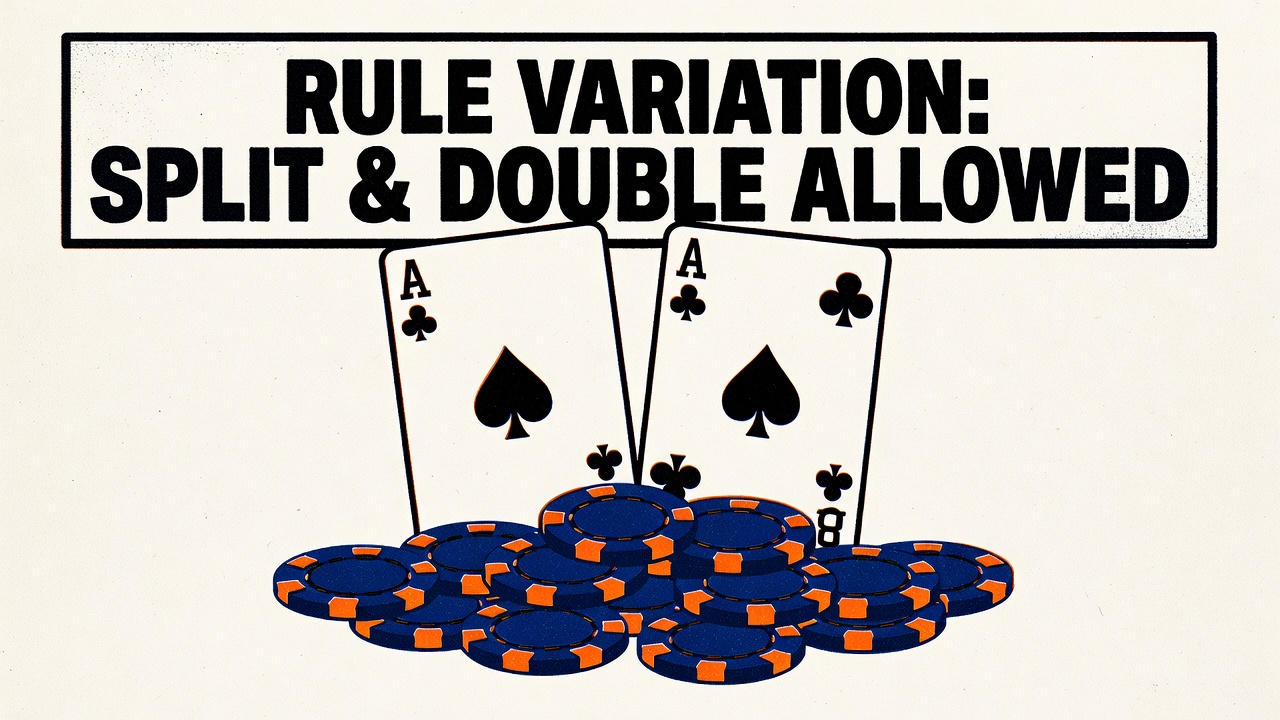
Blackjack rules vary by casino. Some variations favor the player, some favor the house. Understanding which rules matter lets you choose better games.
Double After Split (DAS)
Some casinos allow doubling after splitting a pair. Some do not.
Example: You have a pair of eights. You split them. You receive a new card. You can double down.
This is favorable to the player. DAS improves your winning chances in certain situations.
Surrender
Some casinos offer surrender (give up your hand and lose half your bet). Some do not.
Surrender is favorable to the player, but only in specific situations (like hard 16 vs dealer 10).
Surrender reduces house edge slightly.
Number of Decks
Single-deck blackjack is better for the player than 8-deck blackjack (because card counting is more effective, but also because basic probability shifts).
The house edge is roughly 0.3% lower in single-deck than in 8-deck.
But single-deck blackjack is rare in casinos because it is less profitable for them.
Blackjack Payouts
Most casinos pay 3-to-2 for blackjack. Some pay 6-to-5.
3-to-2 is standard. You get $150 for a $100 blackjack.
6-to-5 is terrible. You get $120 for a $100 blackjack.
The difference in house edge is roughly 1.4%. It adds up over time.
Better Rule Checklist
Look for casinos offering:
- Double after split (DAS)
- Surrender allowed
- Single deck or 2-deck games
- 3-to-2 blackjack payout
- Dealer stands on soft 17
These rules reduce house edge from 1%+ to 0.5% or lower.
Playing at a casino with bad rules (like 6-to-5 payout) versus good rules makes a huge difference.
Pitch and Run
Another rule variation: some casinos allow "pitch and run" where the dealer pitches the card directly to the player instead of placing it on the felt.
This matters slightly for card counting, but for casual players it does not matter.
Soft 17 Rule
The dealer has a soft 17 (ace-six). Some casinos require the dealer to hit soft 17. Some require the dealer to stand.
If the dealer hits soft 17, the house edge goes up roughly 0.2%. This seems small but adds up.
Insurance
Some casinos limit how much insurance you can buy. Some do not. Insurance is a bad bet either way (roughly 2% house edge on insurance).
Skip insurance.
Soft Hand Doubling
Some casinos allow doubling on soft hands (Ace-4). Some do not.
Soft hand doubling is favorable to the player.
The Bottom Line Strategy
Before sitting down at blackjack, ask about the rules. If the casino has bad rules (no DAS, 6-to-5 blackjack payout, no soft doubling), find a different casino.
The difference between playing with good rules versus bad rules is measurable and significant over time.
Broader Implications
Understanding the mechanics of these games and systems is the foundation of rational decision-making. Most players gamble without this understanding. They rely on intuition, tradition, or superstition. This is efficient for the casinos.
For players seeking to minimize harm or maximize information, understanding the structure is essential. The structure is not random. It is designed. Understanding the design allows you to make conscious choices about participation rather than drifting into patterns based on feel.
Moving Forward
Whether you choose to participate in these games is a personal decision. But that decision should be based on full information about expected costs, volatility, and how these systems work. This content provides that foundation.
Rooms for this read
Share this read