Ace Tracking in Blackjack: Theory vs Practice
I knew a card counter who spent six months tracking only aces. He was going to beat the game with one single advantage. I should tell you how it ended, but first, let me back up about a decade.
Pull up a chair.
He came in during the grand opening month. Back then, Atlantic City was still playing deep penetration, maybe eighty percent. Card counters were real problems. The pit boss, a guy named Tony who's dead now God rest him, pointed this kid out. "Watch him," Tony said. "He's only playing heads-up, only tracking something." I watched him for three hours.
The Theory That Looked Airtight
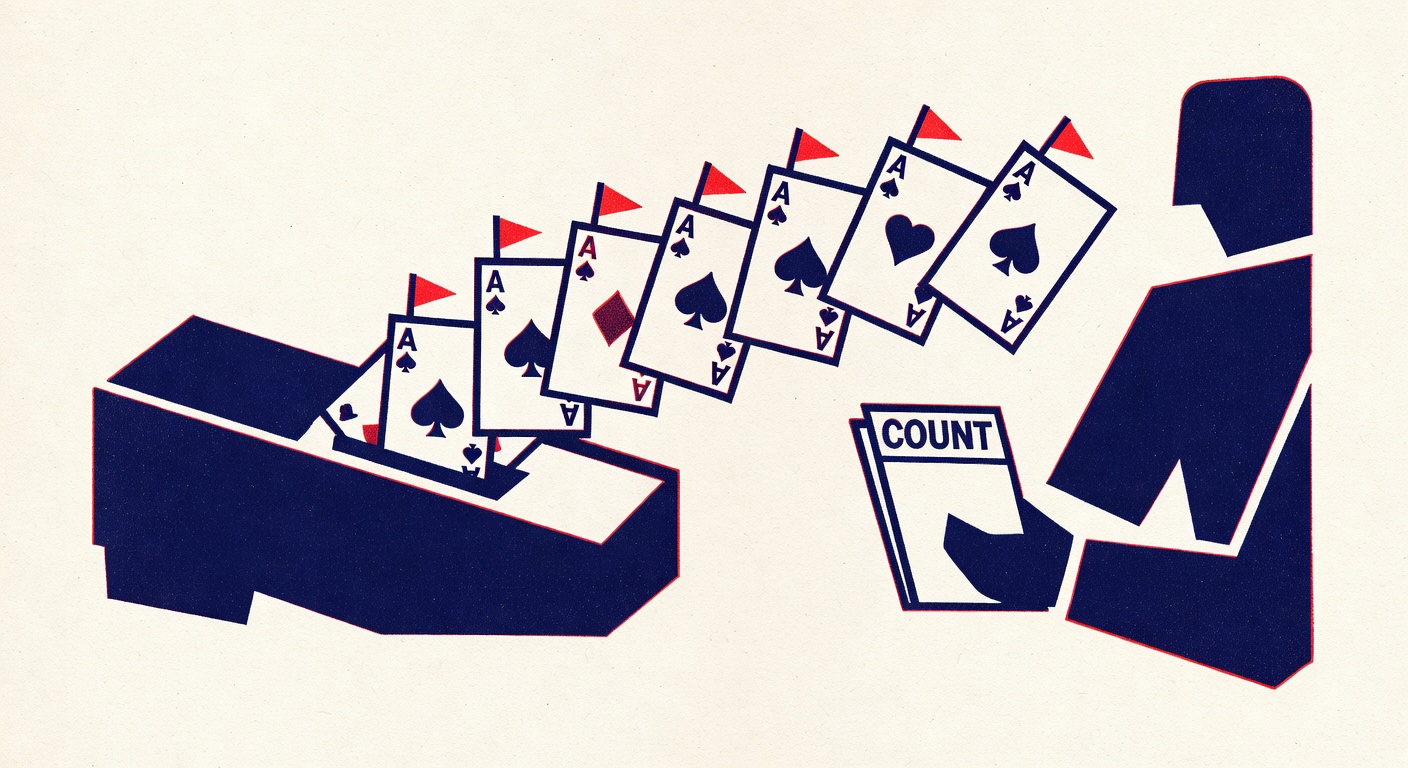
The kid was tracking aces. Only aces. He ignored every other card that came out of the shoe. His system was based on the idea that when aces are depleted, the probability of blackjack drops precipitously. When aces are abundant, blackjack probability rises. Get the ace count right, adjust your bets accordingly, and you've got an edge.
I know this sounds simple, but the math underneath it was sound. An imbalanced deck heavy in aces means the dealer is more likely to bust on sixteen when they're showing a ten. You want to double more often. You want to split more. Blackjack itself pays three to two, so you want to be there when aces are thick. The theory held water.
The kid had run simulations. He'd sat with a computer for six months. He knew that the variance was lower than full counting systems. He knew that the heat from the pit would be lower because he was playing more hands per hour and varying his bets less dramatically. It was a hybrid approach. Smart on paper.
Where Practice Diverged
Then he had to actually execute it.
He sat down at the table and played for ninety minutes. He bet twenty-five dollars a hand. Then he bet fifty dollars. Then he bet one hundred dollars. I watched him. Tony watched him. The other pit boss watched him. When the aces were thick, he wanted to be there. When the aces ran thin, he wanted to leave. But you can't just leave a table. You have to play.
A deck runs one hundred three cards before the reshuffle. That's roughly fifty-four hands of heads-up blackjack. If aces are running thin in hands one through thirty, what do you do? The kid couldn't just sit and wait. He tried to play weaker hands. He tried to stay longer. He tried to stay shorter. The whole time, the count was ticking in his head like an metronome he couldn't silence.
After an hour and forty-five minutes, his eyes were showing that thousand-yard stare you see in combat veterans. His hands were shaking. He'd been focused so completely on the ace count that he'd played hands he shouldn't have played, made decisions that deviated from optimal strategy because his mind was in three places at once.
The Ace Count Looked Fine, But
Here's the thing that nobody who hasn't sat at the table understands. The card count can be perfect, and you can still lose money, because the system doesn't account for emotional noise. The kid had counted two extra aces remaining in a thirty-card shoe. He was mathematically correct. But he'd also sat through eight losing hands in a row while waiting for the good shoe composition. The shoe composition he was waiting for arrived right as his emotional reserves evaporated.
He went all in on two hands in a row when the aces were thick and the expected value was positive. He lost both. Variance. Bad variance, mathematically unlikely, but not impossible. Two hundred dollars vanished. He left the table. Game over.
Tony called me into the office. "He's done," Tony said. "He figured out the count, but he can't use it." We never saw that kid again.
Why Ace Counting Is Theoretically Better But Practically Worse
Ace counting is a legitimate advantage play. The math is correct. The expected value is positive for a player who can achieve and maintain the count. But there are three problems:
First, ace counting creates narrower opportunities than full counting. You're waiting for specific shoe compositions. You miss a lot of hands. You're sitting at the table not playing while your brain calculates whether the shoe is favorable. This is exhausting. Your brain gets tired. Tired brains miscalculate.
Second, ace counting has lower variance than full counting, which sounds good until you realize it also has lower profit per hour. A full counter with the heat of a full counter's bets might make one hundred fifty dollars per eight hours. An ace counter with cooler bets might make eighty dollars per eight hours. That's a massive difference in motivation. You're sitting for fourteen hours a day to make three dollars per hour. Most people quit.
Third, casinos now know about ace counting. They know what they're looking for. A player who sits quietly and suddenly bets double when the aces run high looks like exactly the threat they're trained to spot. A full counter can disguise their behavior by varying bets across different card values. An ace counter has only one trigger. You're obvious.
The Real World Doesn't Run Simulations
The kid had done the math. He'd run a million hands of simulation. He'd calculated variance. Everything suggested the system would work. But simulation isn't a casino. Simulation doesn't have pit bosses and cocktail waitresses and drunk tourists at the adjacent table yelling every time their hand loses. Simulation doesn't have the player's own fear and hope affecting decision-making.
I'll tell you what happened to that kid. He tried three more casinos. He quit each one. He went back to his job in IT. Last I heard, he was still calculating poker odds for a living. The distance between perfect theory and imperfect reality had beaten him.
That's the story. Sometimes the simplest system is the one that breaks you first.
Rooms for this read
Share this read