Double Exposure Blackjack: The Catch Behind Seeing the Dealer's Cards
In Double Exposure Blackjack, you see both the dealer's cards before making decisions. This sounds advantageous. The catch is subtle but important.
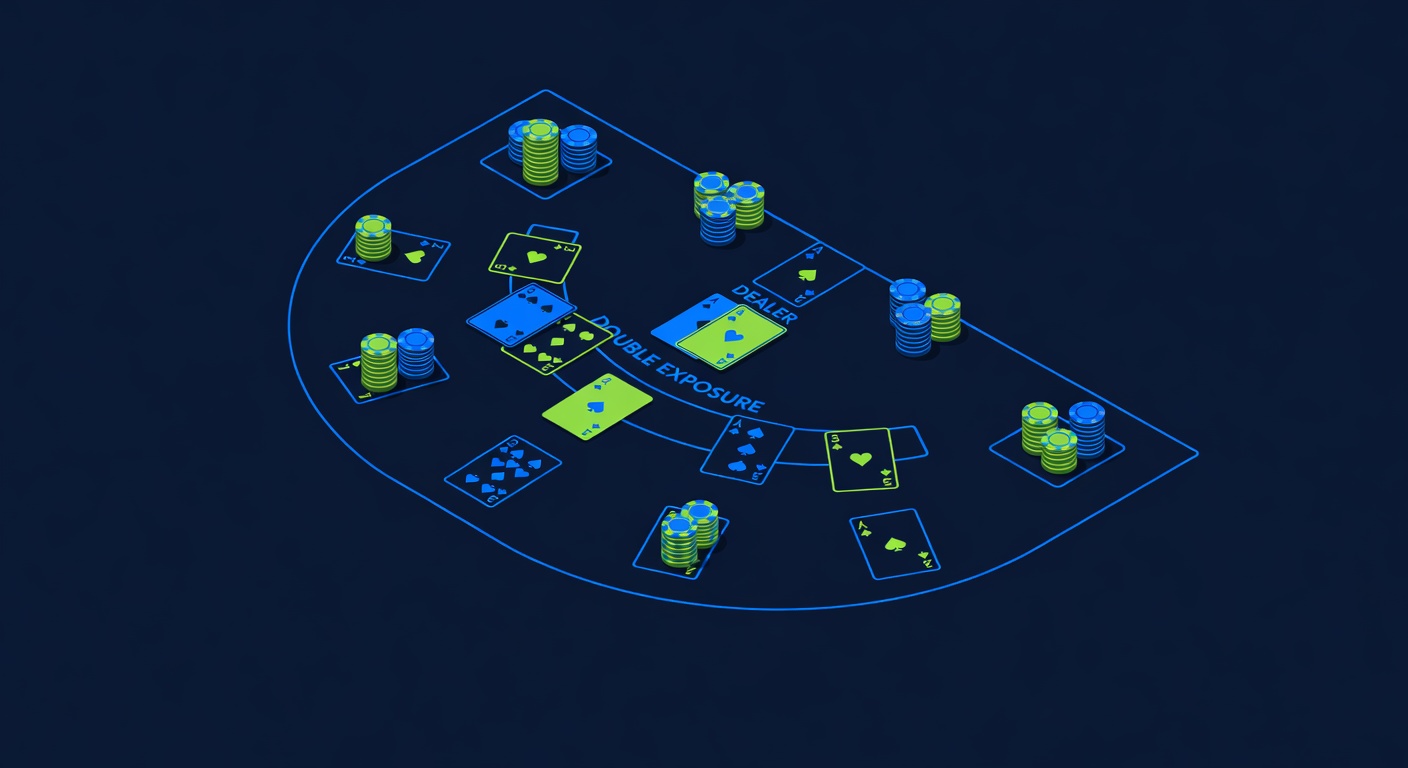
Double Exposure Blackjack shows you the dealer's hole card immediately. You can see what the dealer has. You then decide whether to hit, stand, double down, or split.
This should be enormous advantage. You have information the dealer does not. But casinos have adjusted to prevent this advantage from being too large.
The adjustments:
First, the blackjack payout. In regular blackjack, a natural blackjack pays 3-to-2. In Double Exposure, it might pay 1-to-1 or even lower. This reduces your win value on your best possible hand.
Second, dealer rules. In regular blackjack, the dealer stands on 17. In Double Exposure, the dealer might hit on soft 17 or use other rules that increase their win rate.
Third, push rules. In regular blackjack, if both you and the dealer have the same hand, it is a push (tie) and you get your money back. In Double Exposure, a tie might be a dealer win or a reduced payout.
The result: Even with information about the dealer's cards, the house edge is still present. Double Exposure typically has a house edge of around 0.4 to 0.6 percent, compared to 0.5 percent on regular blackjack with basic strategy.
The advantage of seeing the cards is real but offset by the rule adjustments. You can make better decisions with the information, but the payout structure ensures the house still profits.
This is a lesson in how casinos respond to advantage. Give players an advantage in game design, and the casino adjusts the payouts or rules to maintain the edge. The advantage you perceive is largely neutralized.
The perception gap: Players usually feel Double Exposure is a better option than regular blackjack because they see the cards. The reality is the adjusted rules offset the information advantage. The house edge is similar. The game feels different but the math is the same.
The Underlying Mechanics
Understanding the basics of how this topic functions requires looking at the incentive structures and the economic pressures that shape behavior. The players involved are responding to rational incentives, even when those incentives lead to outcomes that seem suboptimal from an outside perspective.
The decision-making process at each step is not random. It is shaped by historical precedent, regulatory pressure, and the competitive landscape. When one operator makes a move, others follow or diverge based on their specific market position and clientele.
The Long-Term Implications
Over years and decades, these patterns compound. Small edges add up. Small behavioral nudges accumulate. The gap between casual understanding and sophisticated understanding becomes enormous.
A player who grasps the mechanics at a deep level can operate with an advantage. They can navigate the landscape in ways that the casual participant cannot. This is true in virtually every gambling domain. The edge belongs to those who understand the fine details.
The future will likely see further refinement and complexity. As the market matures and competition increases, operators will continue optimizing their offerings. Players will continue developing better strategies. The arms race continues indefinitely.
Rooms for this read
Share this read