Blockers in Poker: How They Shape Bluffing Decisions
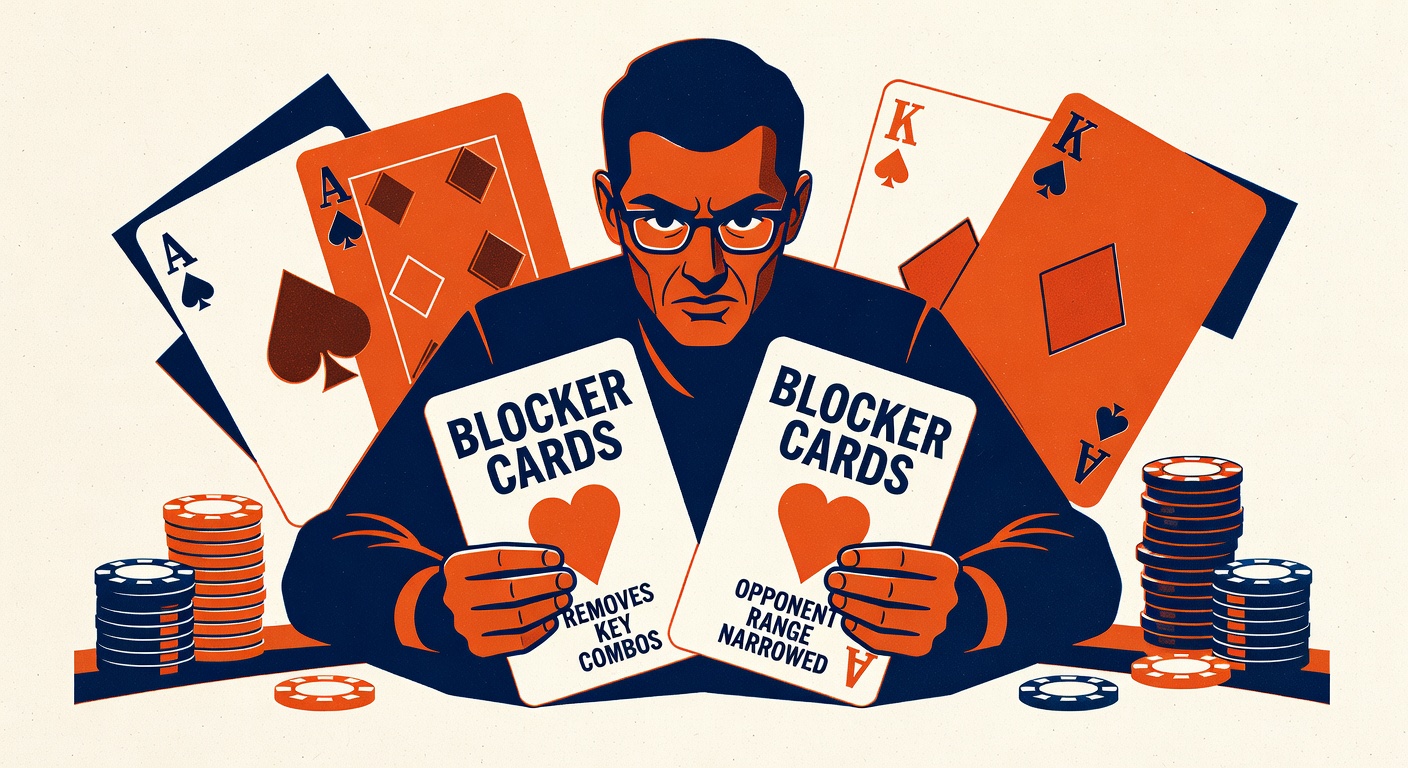
A blocker is a card in your hand that reduces the probability that your opponent holds a specific hand. Blockers are subtle. They are also powerful. They change when bluffing is correct.
You hold Ace-King in a position where you might bluff. The board shows 9-8-4. You have no pair, no draw. You are considering a bluff.
The blocker effect: You hold an ace. If your opponent has a made hand, they are less likely to have an ace in it. By blocking an ace, you reduce the range of hands that beat you.
A simplified example: Your opponent can have strong hands (QQ, TT) or weak hands (K7, Q2). If you have an ace, you block the possibility of AK, AQ, and other ace-containing hands. This shrinks their possible strong-hand range.
Why this matters: If you have a blocker, your bluff has better fold equity because your opponent's strong-hand range is narrower. The blocker changes the expected value of the bluff.
How to use it: When deciding whether to bluff, consider what cards you hold. If you hold a card that is valuable in your opponent's strong hands, you have a blocker. Blockers increase bluff equity.
The inverse: If you hold a card that is valuable in your opponent's weak hands, you have reduced bluff equity. An example: you hold a 9 and the board shows 9-8-4. You have many hands that make nine, so your opponent is more likely to fold seeing a nine on the board.
Practical use: Blockers are subtle. Most players do not consciously think about them. But the best players do. They adjust bluffing frequency based on how many blockers they hold.
The advanced blocker strategy: Game theory optimization in poker now includes blocker counting as a standard element. Players adjust ranges and bet sizing based not just on what they hold but on what hands they block.
The Underlying Mechanics
Understanding the basics of how this topic functions requires looking at the incentive structures and the economic pressures that shape behavior. The players involved are responding to rational incentives, even when those incentives lead to outcomes that seem suboptimal from an outside perspective.
The decision-making process at each step is not random. It is shaped by historical precedent, regulatory pressure, and the competitive landscape. When one operator makes a move, others follow or diverge based on their specific market position and clientele.
The Long-Term Implications
Over years and decades, these patterns compound. Small edges add up. Small behavioral nudges accumulate. The gap between casual understanding and sophisticated understanding becomes enormous.
A player who grasps the mechanics at a deep level can operate with an advantage. They can navigate the landscape in ways that the casual participant cannot. This is true in virtually every gambling domain. The edge belongs to those who understand the fine details.
The future will likely see further refinement and complexity. As the market matures and competition increases, operators will continue optimizing their offerings. Players will continue developing better strategies. The arms race continues indefinitely.
Implementation Details
The technical specifics matter more than most players understand. The details in the fine print are where the house protects its edge and where careful players find opportunities. Reading those details is tedious but essential for rational decision-making.
Strategic Considerations
From a broader strategic perspective, players need to evaluate their options based on complete information. The marketing message is never the whole story. The regulatory framework shapes what is possible. The competitive landscape determines what is offered.
The savvy player treats each interaction as a data point in a larger pattern. Over time, patterns emerge. Opportunities surface. The player who has done their homework can capitalize on gaps in the market or the law.
The Competitive Dynamic
Every casino operator is competing for players and profits. The competition drives innovation in both positive and negative directions. Some innovations genuinely improve the player experience. Others simply accelerate the rate at which players lose money.
Understanding which is which requires critical thinking and skepticism toward marketing claims. The operator's interests and the player's interests are rarely aligned. The player who forgets this fundamental reality is the player who loses the most money.
The Rational Approach
The only defensible approach is to enter these situations with eyes open about the odds, the house edge, and your own vulnerability to cognitive biases. Make decisions based on math, not emotion. Set limits and stick to them. Accept losses as part of the cost of participation.
The player who does these things might still lose money. The house edge is real. But they will lose less money than the player who ignores these principles, and they will maintain their dignity throughout the process.
Rooms for this read
Share this read