Craps Hardways: Payouts, Odds, and Realistic Expectations
A hardway bet in craps pays 7-to-1 or 9-to-1 depending on the number. Sounds good until you calculate the actual house edge, which is approximately 9.1%. Here is what the odds actually mean.
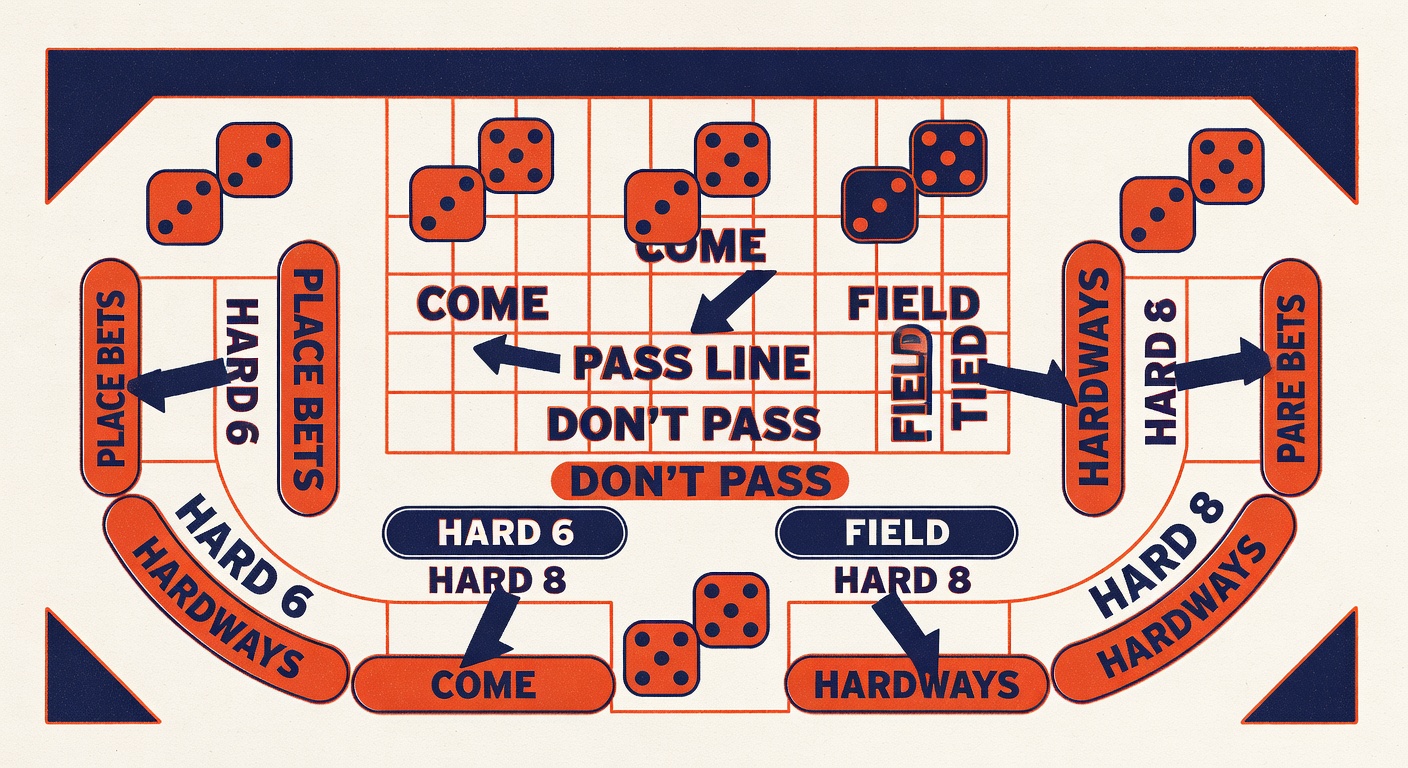
In craps, a hardway bet means you are betting that a specific number will come up doubled before a seven appears. A hard four is rolling two-two. A hard six is rolling three-three. A hard eight is rolling four-four. A hard ten is rolling five-five.
The payout on a hard four is 7-to-1. The payout on a hard six or eight is 9-to-1. The payout on a hard ten is 7-to-1.
The house edge on these bets is approximately 9.1% on hard four and hard ten. The house edge on hard six and hard eight is 9.09%. This is high compared to pass line bets at 1.41%.
Why the house edge is high: The probability of rolling a hard four before a seven is low. You can roll a hard four (two-two). You can also roll an easy four (one-three), and that loses your hardway bet immediately because the four came but not hard. The odds shift heavily in the house favor.
Calculate it yourself. There are 36 possible rolls with two dice. To roll a hard four, you need two-two, which is 1 combination. To roll a seven, you have six combinations. To roll an easy four, you have one-three and three-one, which are 2 combinations.
If you are betting hard four, you win if two-two appears before a seven. The probability is roughly 1 / (1 + 6) = 14.3%. If the payout is 7-to-1, the expected value to you is 14.3% times 7 times your bet minus the 85.7% chance you lose. That is a house edge of approximately 9.1%.
Why people make these bets: They appear occasionally in craps. The high payout creates excitement. A seven-to-one winner feels significant. The player making the bet is usually in an elevated emotional state from previous wins.
Hardway bets are called proposition bets. Craps tables offer many proposition bets, all with house edges of 5% to 16%. The casino displays these on the felt layout. The stickman calls them out. The availability creates temptation.
A disciplined craps player makes only pass line, don't pass, come, don't come, and odds bets. These have house edges below 2%. The hardway bets are distractions. They are available specifically because they have high house edges and the casino profits from them.
The hardway odds: The true odds of rolling a hard six are 10 to 1 (one way to make it: three-three, versus ten ways to make a six but not hard: one-five, five-one, two-four, four-two). A 9-to-1 payout leaves 1 percent for the house, but you must account for the easy ways to make the number that lose immediately. The real house edge is 9.09 percent when you factor in all possibilities.
The Underlying Mechanics
Understanding the basics of how this topic functions requires looking at the incentive structures and the economic pressures that shape behavior. The players involved are responding to rational incentives, even when those incentives lead to outcomes that seem suboptimal from an outside perspective.
The decision-making process at each step is not random. It is shaped by historical precedent, regulatory pressure, and the competitive landscape. When one operator makes a move, others follow or diverge based on their specific market position and clientele.
The Long-Term Implications
Over years and decades, these patterns compound. Small edges add up. Small behavioral nudges accumulate. The gap between casual understanding and sophisticated understanding becomes enormous.
A player who grasps the mechanics at a deep level can operate with an advantage. They can navigate the landscape in ways that the casual participant cannot. This is true in virtually every gambling domain. The edge belongs to those who understand the fine details.
The future will likely see further refinement and complexity. As the market matures and competition increases, operators will continue optimizing their offerings. Players will continue developing better strategies. The arms race continues indefinitely.
Rooms for this read
Share this read