Blackjack Insurance: Why Most Strategy Guides Say to Skip It
Q: What is blackjack insurance and should I take it? A: Insurance is a side bet that the dealer has blackjack. It sounds protective. It is actually a bad bet for almost everyone.
Q: What is insurance in blackjack?
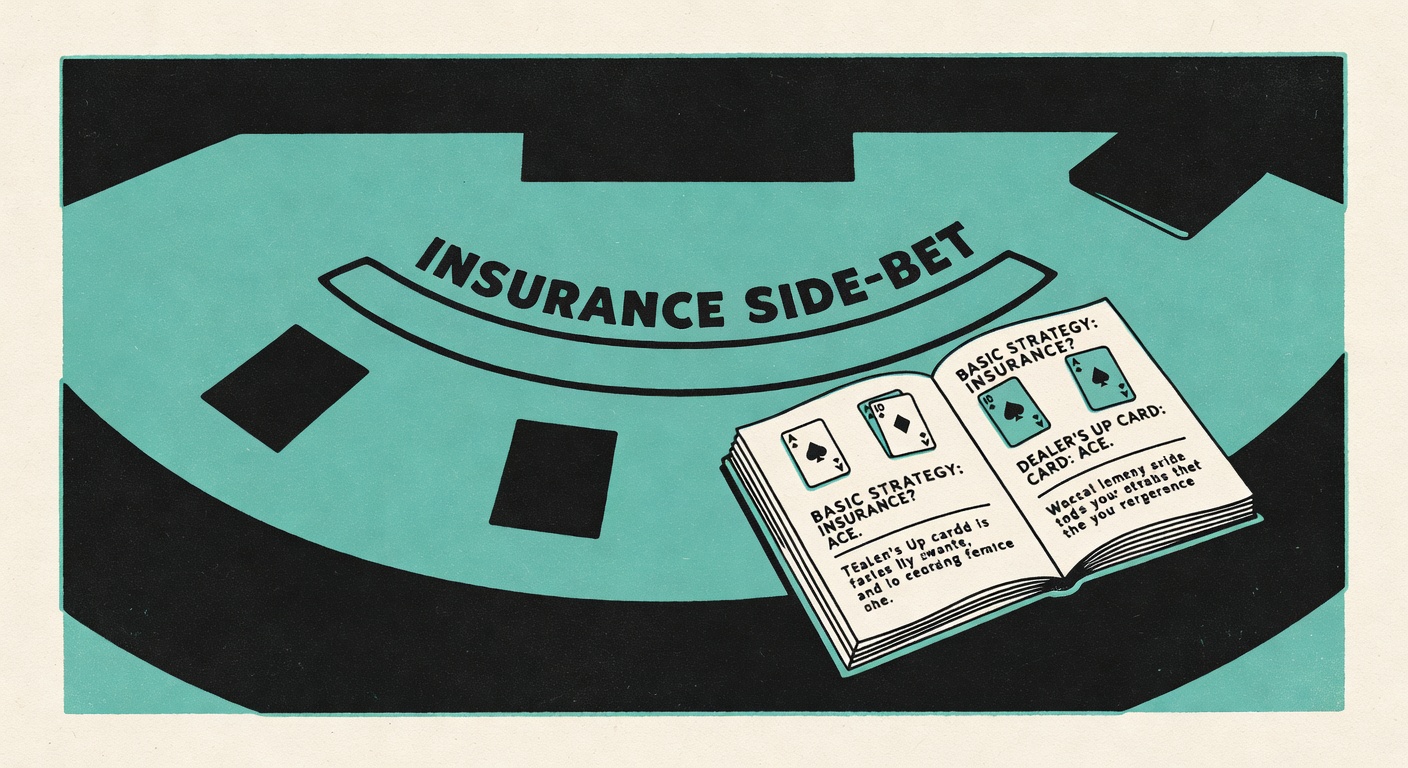
A: When the dealer's up-card is an ace, the dealer offers insurance. You can bet up to half your original bet that the dealer's hole card is a ten-value card, completing a blackjack.
Q: What does insurance pay?
A: Insurance pays 2-to-1. If you bet $100 on a hand and then take $50 in insurance, and the dealer has blackjack, you lose your $100 original bet but win $100 on the insurance, for a net of zero loss.
Q: Why would I take insurance?
A: It seems protective. You are protecting yourself against losing your hand to blackjack. If the dealer does have blackjack, you break even instead of losing.
Q: Why do strategy guides say to skip it?
A: The mathematics. The probability that the dealer's hole card is a ten-value is 30.77 percent (16 ten-value cards out of 52 total). Insurance pays 2-to-1, implying a probability of 33.3 percent. The true probability is lower. The expected value of insurance is negative.
A: Over time, taking insurance costs you money. The house edge on insurance is approximately 5.4 percent. By comparison, the house edge on blackjack itself is less than 1 percent with basic strategy.
Q: Is there any time insurance is good?
A: Card counters might take insurance when the remaining deck has an unusually high proportion of ten-value cards. Their count shows the true probability is above 33.3 percent. For the rest of us, insurance is a bad bet.
Q: Why does the dealer offer it?
A: Because players take it and lose money. It is a profit center for the casino.
The card counter exception: A professional card counter at blackjack might have a situation where insurance is profitable if they know the remaining deck has an unusually high concentration of ten-value cards. For everyone else, insurance is a losing proposition perpetually.
The Underlying Mechanics
Understanding the basics of how this topic functions requires looking at the incentive structures and the economic pressures that shape behavior. The players involved are responding to rational incentives, even when those incentives lead to outcomes that seem suboptimal from an outside perspective.
The decision-making process at each step is not random. It is shaped by historical precedent, regulatory pressure, and the competitive landscape. When one operator makes a move, others follow or diverge based on their specific market position and clientele.
The Long-Term Implications
Over years and decades, these patterns compound. Small edges add up. Small behavioral nudges accumulate. The gap between casual understanding and sophisticated understanding becomes enormous.
A player who grasps the mechanics at a deep level can operate with an advantage. They can navigate the landscape in ways that the casual participant cannot. This is true in virtually every gambling domain. The edge belongs to those who understand the fine details.
The future will likely see further refinement and complexity. As the market matures and competition increases, operators will continue optimizing their offerings. Players will continue developing better strategies. The arms race continues indefinitely.
Rooms for this read
Share this read