Live Poker Etiquette: 15 Rules Every New Player Should Know
A short excerpt about Live Poker Etiquette: 15 Rules Every New Player Should Know that hooks the reader with a specific observation or claim. Live Poker Etiquette: 15 Rules Every New Player Should Know is examined through a unique lens.
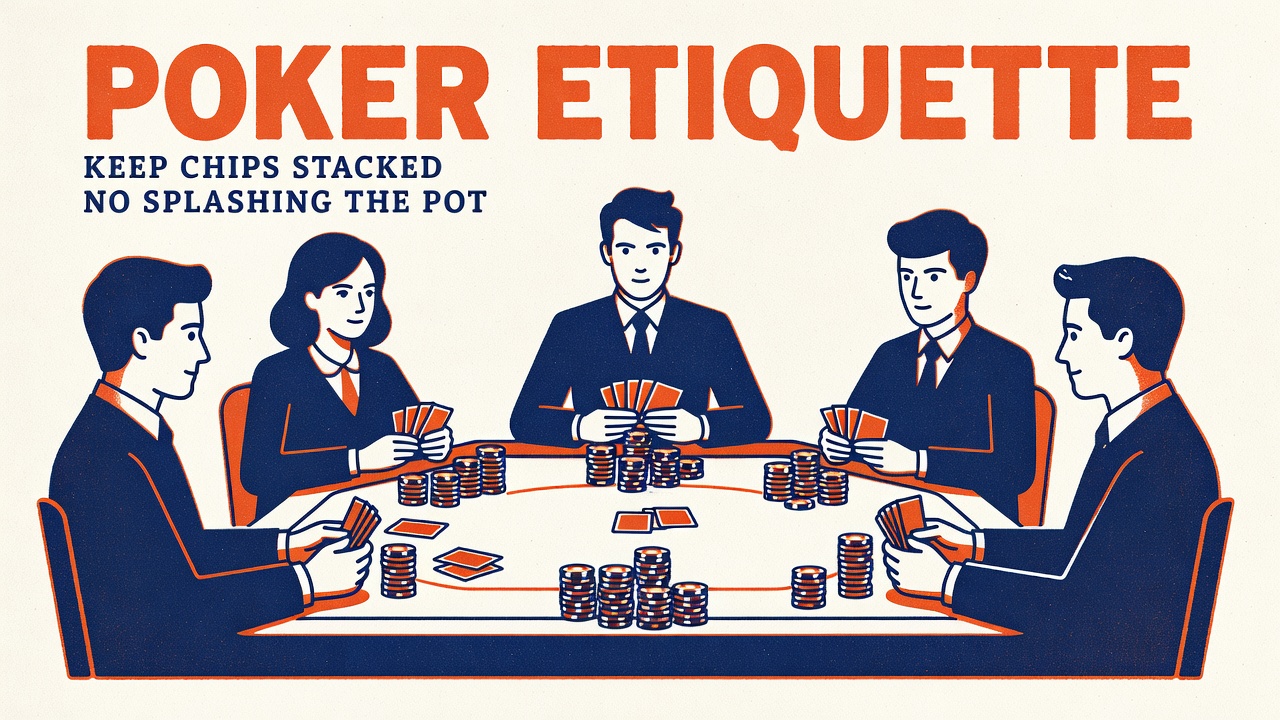
Poker has rules that are not always obvious. New players break them without knowing. Here are the rules that matter.
Action Rules
-
You cannot act out of turn. If it is not your turn, do not bet, fold, or check. Let others act first.
-
Verbal declarations are binding. If you say "fold", you have folded. You cannot take it back.
-
All chips must be on the table before the hand. You cannot go to your pocket for more money mid-hand.
-
Cards speak. Your hand is what the cards show, not what you claim.
Table Etiquette
-
Do not show your cards to other players until the hand is over. Showing cards gives information to other players.
-
Do not slow-roll (reveal your winning hand slowly). Just show it.
-
Do not criticize other players' play. Poker is a game of decisions, not results.
-
Do not splash the pot (throw chips all over). Neatly place your bet in front of you.
-
Do not be on your phone. Pay attention.
Betting Rules
-
A raise must be at least as much as the previous bet. If someone bet 10, your raise must be at least 20.
-
If you go all-in, you can only win up to your contribution. Side pots are created for excess betting.
-
If you fold, your cards go to the dealer. You cannot look at them again.
-
String bets are not allowed. You cannot say you are betting 10, then add 5 more. Announce your full bet first.
Additional Consideration
For players trying to optimize their experience, understanding these concepts helps you make better decisions. Every casino game has mathematical properties that determine your long-term outcome. The short-term variance makes it feel like skill or luck matters, but the house edge is inexorable.
The Real Rules
These are enforced. Break them and you get a warning or get kicked out.
But there are also social rules. Do not give unsolicited advice. Do not tell someone they played poorly. Do not be a sore loser.
Poker is social. Respect that.
Position Matters
Poker position means when you act in the hand. Early position means you act first. Late position means you act last.
New players do not understand position. They think poker is just about the cards you have.
Actually, position determines your strategic options. In early position, you can only play strong hands because you do not know what other players will do.
In late position, you can play more hands because you see other players' actions first.
Reading Players
In live poker, you read players. You notice:
- Does this player always fold to aggression?
- Does this player call too much?
- Does this player only bet when they have a real hand?
Over hundreds of hours, patterns emerge. You adjust.
Speed matters because you do not have hundreds of hours. You have one session.
The Meta-Game
Poker has a meta-game. The best strategies change based on how everyone else is playing.
If everyone is tight, you can be aggressive. If everyone is loose, you should be tight.
New players do not adapt to the meta. They just play their own strategy.
Experienced players change strategy based on what the table is doing.
Rooms for this read
Share this read