How Bookmakers Set Their Odds: A Look Behind the Scenes
A bookmaker does not predict the outcome. They predict how people will bet. The odds serve a single purpose: balance action. Everything else is window dressing.
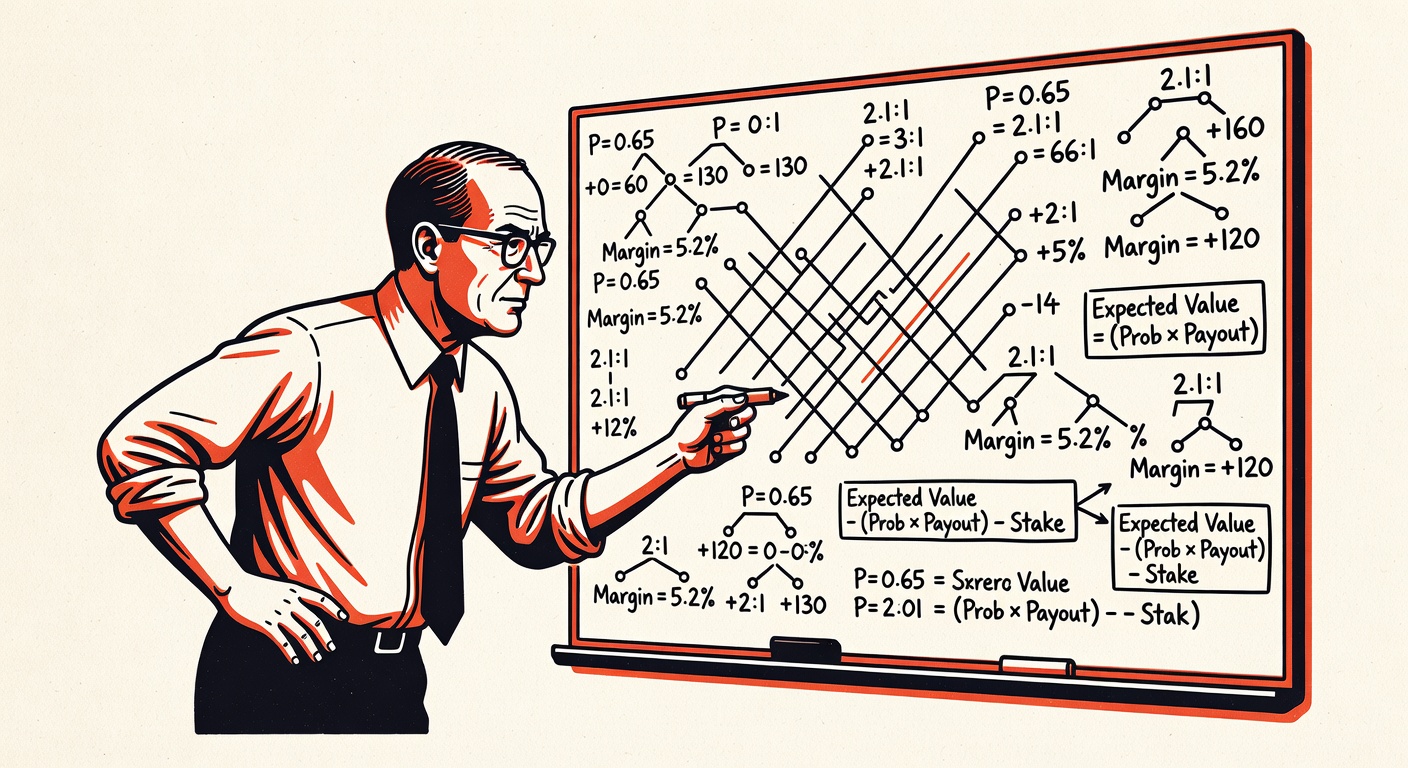
The bookmaker opens the line at 1.80 for the favorite and 2.20 for the underdog. This is not a prediction about which team will win. This is a prediction about how much money will come in on each side.
The mathematics of the line: If equal money comes in on both sides at a 1.80 / 2.20 split, the bookmaker makes money either way. Suppose one hundred thousand dollars comes in on each side. If the favorite wins, the bookmaker pays out one hundred thousand times 1.80 minus one hundred thousand, which is eighty thousand. The bookmaker keeps one hundred thousand from the losing side. Net profit: twenty thousand.
If the underdog wins, the bookmaker pays out one hundred thousand times 2.20 minus one hundred thousand, which is one hundred twenty thousand. The bookmaker keeps one hundred thousand from the losing side. Net profit: twenty thousand. Either way, the bookmaker profits because the odds were calibrated to balance action.
But action never balances perfectly. The favorite gets more money. The line must shift to encourage underdog betting and discourage favorite betting. The bookmaker lowers the odds on the favorite (1.75 instead of 1.80) making it less attractive. The bookmaker raises the odds on the underdog (2.30 instead of 2.20) making it more attractive.
The goal is action equilibrium. When roughly equal amounts of money are on each side, the bookmaker stops moving the line and lets the game happen.
This is why the line changes during the week before a game. New information arrives. If a key player is injured, sharp bettors know this immediately. They bet the underdog. The line shifts. Casual bettors see the shifted line on Wednesday evening and do not understand that the shift is based on information they do not have yet.
The best bookmakers do not try to predict outcomes. They try to predict bettors. How will New York bettors react to the news? How will West Coast bettors react? How will sophisticated bettors react and when will they act?
A casino architect understands the bookmaker's office as a machine. Information flows in. Odds are adjusted. Money flows. The machine maintains balance. The architect's job is to understand the mechanics of the machine and optimize for flow.
The long-term edge: Understanding odds and adjusting bets based on line movement is the foundation of professional sports betting. The best bettors are not psychics. They are analysts who identify when the market has mispriced the probability of an outcome. The bookmaker's job is to balance action. The bettors' job is to find the imbalances. The conflict between them creates the market.
The Underlying Mechanics
Understanding the basics of how this topic functions requires looking at the incentive structures and the economic pressures that shape behavior. The players involved are responding to rational incentives, even when those incentives lead to outcomes that seem suboptimal from an outside perspective.
The decision-making process at each step is not random. It is shaped by historical precedent, regulatory pressure, and the competitive landscape. When one operator makes a move, others follow or diverge based on their specific market position and clientele.
The Long-Term Implications
Over years and decades, these patterns compound. Small edges add up. Small behavioral nudges accumulate. The gap between casual understanding and sophisticated understanding becomes enormous.
A player who grasps the mechanics at a deep level can operate with an advantage. They can navigate the landscape in ways that the casual participant cannot. This is true in virtually every gambling domain. The edge belongs to those who understand the fine details.
The future will likely see further refinement and complexity. As the market matures and competition increases, operators will continue optimizing their offerings. Players will continue developing better strategies. The arms race continues indefinitely.
Rooms for this read
Share this read