

How Slot Tournaments Work and How to Enter
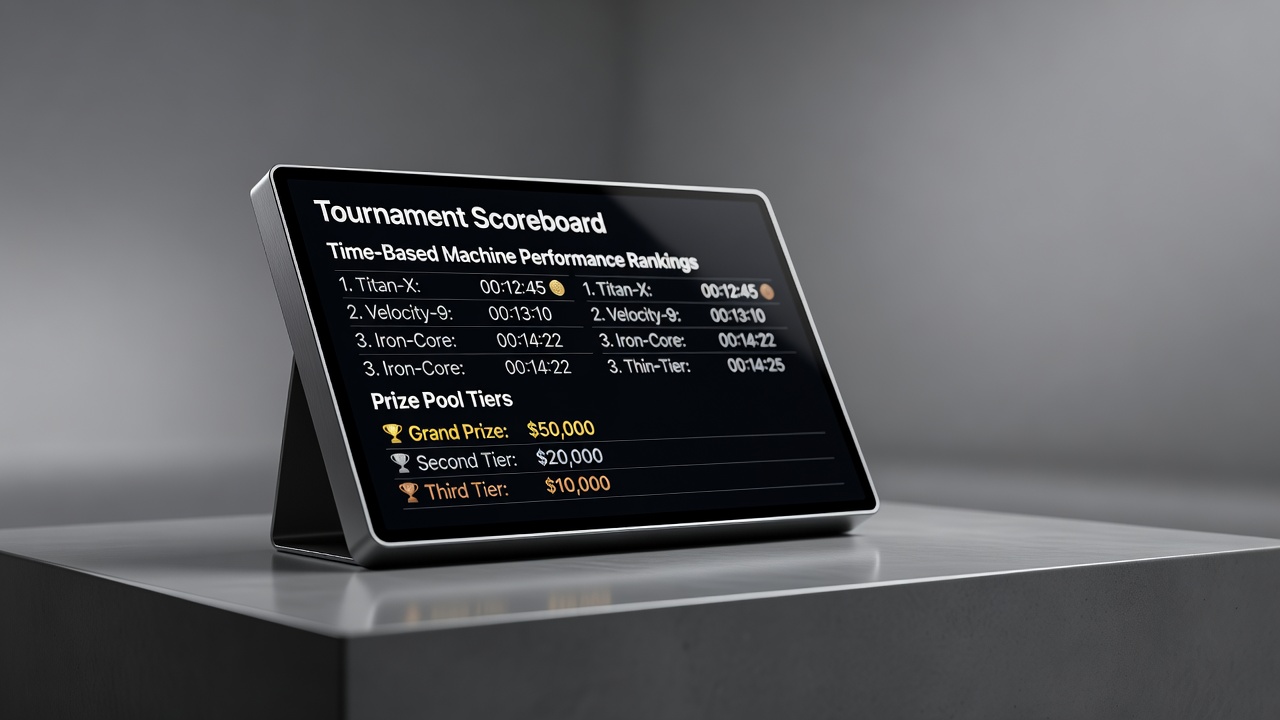
Slot tournaments are scheduled competitions where players compete for prizes based on machine performance over a set time. Entry is typically fee-based, and prize pools are predetermined.
The full read
In a high-limit room, we see tournaments. Not often, but regularly. A casino announces a slot tournament: play these machines from 2pm to 4pm on Saturday. Entry fee is $100. Prize pool is $5,000. The top ten players by total winnings share the pool. It is structured competition applied to machines that are, individually, games of pure chance.
The mechanics are simple. You buy in (pay the entry fee). You receive credits (the amount varies, sometimes equal to your buy-in, sometimes a multiple). You play designated slot machines within a set time window. The casino tallies your final credit balance. The player with the highest balance wins the most money from the prize pool. The player with the lowest balance wins nothing (or a small consolation prize).
Entry can be individual or in groups. Some tournaments have buy-ins of $50; others require $1,000 or more. The buy-in determines the prize pool size. A tournament with 100 players at $100 buy-in generates a $10,000 prize pool. That prize pool is divided among winners according to the tournament rules (usually top 10 to top 20 finishers get prizes).
The appeal to casinos is straightforward: the entry fees are pure profit. A $100 buy-in tournament generates $10,000 in entry fees from 100 players. The casino uses that money to fund the prize pool (say, $5,000) and keeps the difference ($5,000 in profit). The players are motivated because they believe they can win prize money through skill at timing or selection of machines.
This belief is partially justified and partially illusory. The outcome of slot machines is determined by random number generators, not by player timing. But tournaments do allow players to compete fairly (all playing identical machines under identical conditions) where individual play does not. A single player's advantage or disadvantage from machine randomness is mitigated by the tournament structure: everyone faces the same variance.
"Slot tournaments create the possibility of skilled competition in a game without skill. The competition is luck-based but structured fairly."
Entry to tournaments varies by casino. Some require pre-registration (you sign up in advance). Others allow walk-ups (you show up at the start time and buy in). Larger tournaments require pre-registration to manage participation and payout logistics.
Stakes vary widely. Local casinos might run low-buy-in tournaments ($25-$50 entry) with modest prize pools ($500-$1,000). Las Vegas or regional casinos run higher-stakes tournaments ($500-$5,000 entry) with substantial prize pools ($50,000+). The highest-stakes tournaments attract serious players willing to risk significant capital.
Frequency also varies. Some casinos run tournaments weekly. Others run them monthly or on special occasions. A casino with a large slot floor might run multiple tournaments simultaneously on different machines to spread players and manage capacity.
Strategy within a slot tournament is limited. You want to build credit as quickly as possible, which typically means playing max bet (wagering the maximum allowed on each spin to maximize potential payouts). You want to play machines that are performing well (others are winning, so those machines are hitting more frequently). You want to avoid tilting (playing emotionally instead of systematically).
One consideration: some players use time strategically. Slot tournaments often have a mid-point announcement ("two minutes remaining"). Experienced players adjust their play in the final stretch: if they are ahead, they might slow down and protect their lead. If they are behind, they might increase bet size to catch up. These are marginal adjustments on a random game, but they provide the illusion of strategic depth.
Rooms for this read
Share this read





