The Best Way to Learn Baccarat Without a Coach
Baccarat is a game of zero skill, but learning the social mechanics and variance patterns takes time. Teaching yourself without a paid coach requires patience and specific drill sequences that most tutorials skip.
You can learn the rules of baccarat in five minutes. Banker or Player. Bet on one. Cards are dealt. Winner takes pot. Tie is possible but rare. You do not need a coach for this part.
What takes time is learning what baccarat actually feels like when you are losing. That is the thing nobody teaches you. You read a book or watch a YouTube video and you understand the math. 50-50 game with a small house edge. Simple. Then you sit at a table (or at a live-dealer terminal) and you lose six hands in a row. Or you win three times and lose seven. The variance is real. It is not theoretical. Your gut tells you the game is rigged. It is not. Your sample size is just small.
Learn baccarat by playing small amounts first. I do not mean betting one dollar when you want to risk fifty. I mean playing for hours on end with minimal stakes: 10 cents, 25 cents, 50 cents per hand. A hand of baccarat resolves in 10 seconds. You can play a hundred hands in fifteen minutes. After a hundred hands, patterns emerge. You see that Banker wins roughly 51% and Player wins roughly 49%. You see that the edge is real: Banker pays 95 cents on the dollar (due to the 5% commission the house takes). You see this empirically, not theoretically.
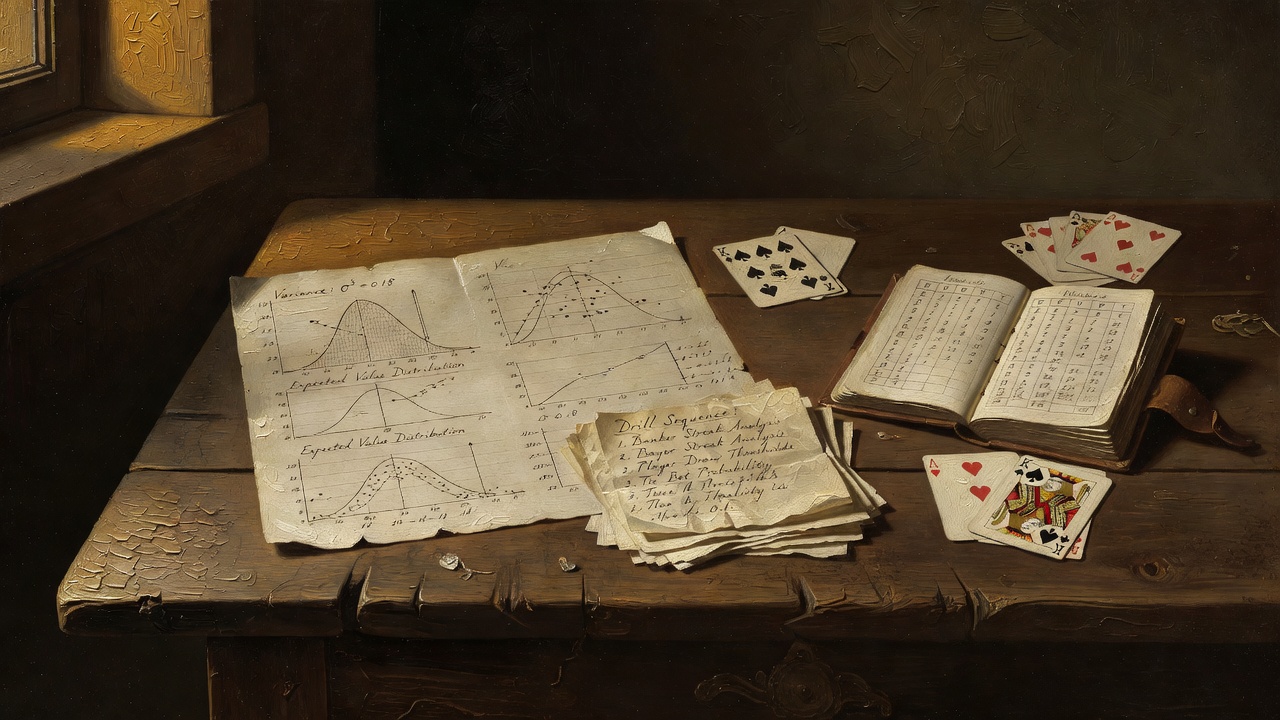
Do this for a week. Play 5,000-10,000 hands at minimal stakes. You will spend 10-20 dollars and your brain will internalize what variance looks like. You will stop expecting streaks to reverse. You will stop thinking the last three Banker wins mean Player is "due." You will accept the game for what it is: a constant 50-50 proposition with a slight house edge.
Pattern Recognition and Betting Sequences
After the low-stakes grind, you can research betting sequences. Do not waste time on them; they do not work. But understanding why they are tempting is valuable. Baccarat players often track which side (Banker or Player) won the last hand. The reasoning: maybe there is a pattern. There is not. Each hand is independent. But the human brain is a pattern-seeking machine, and two consecutive wins by the same side feel significant. They are not.
Read Peter Griffin's math. Read Doyle Brunson's opinions (though he is a poker expert first, gambler second). Read actual casino floor guides that explain baccarat's economics, not its mystique. The mystique is seductive and false. The economics are boring and true: the game is slightly favoring Banker, slightly favoring house, and you cannot do anything about it through betting strategy.
Play at different limits. Move from 10 cents to 50 cents to 1 dollar. The rules do not change. Your emotional response does. A 50-hand losing streak costs ten cents at low stakes. It costs fifty dollars at higher stakes. That difference in emotional impact is real. You learn it by experiencing it. When you reach the limit where a bad streak bothers you, you have found your threshold. That threshold is useful information about your own risk tolerance.
"Baccarat teaches you about variance because there is nothing else to learn. The game has no hidden strategies. It just shows you what 5000 independent coin flips look like."
Watch live baccarat broadcasts on YouTube or your platform's live-dealer stream. Do not play these; just watch. Observe the balance of Banker and Player wins over a long session. Notice how random it appears. Notice how every eighth or tenth hand seems to break a streak. This is what probability looks like. It does not feel like you expect it to feel. It is both more predictable (in long-run frequencies) and less predictable (in short-run sequences) than intuition suggests.
The final step is playing at your actual limit. Once you understand the game's variance and the house edge is non-negotiable, you can choose your bet size. That choice determines how many hands you can afford to play and how long you can sustain your bankroll. This is personal risk management, not strategy. It is also the part that matters most and that no coach can teach you. You learn it by doing it.
Baccarat is not a game to master. It is a game to understand and then to decide whether the terms are acceptable to you. Most bettors never reach that clarity because they keep hoping for a system. There is no system. There is only probability, variance, and your own time-preference.
Rooms for this read
Share this read