

Charles Fey and the Invention of the Modern Slot Machine
Charles Fey invented the Liberty Bell in 1895. It was the first machine with automatic payouts. Before that, slot machines had no mechanism to return money. Fey solved this problem mechanically.
The table at Macau, the baccarat players, the careful precision of shuffling, the whisper of the cards. This all traces back to Charles Fey and a problem he solved one hundred and twenty-nine years ago: How do you pay a player without a human being present?
The Pre-Fey Landscape
Before 1895, gambling machines existed. They were usually configured to pay out in cigars or drinks, not money. This avoided the legal issue of operating an unlicensed gambling house. The machines were the middle step between saloon and formal casino.
These early machines had mechanical reels. Three or more reels with symbols. A player pulled a lever. The reels spun. The reels stopped. If the symbols matched, the player won. But the win was not automatic. The machine had no payout mechanism. A bartender would see the winning symbols and hand over the prize.
This worked, but it was not scalable. A bartender had to watch the machine. Dishonest bartenders could refuse payouts. Honest bartenders had to keep physical prizes on hand.
Fey's Innovation
Charles Fey was a mechanic from San Francisco. He designed machines for a gaming parlor. He recognized the bottleneck: payouts required human intervention. What if the machine could pay automatically?
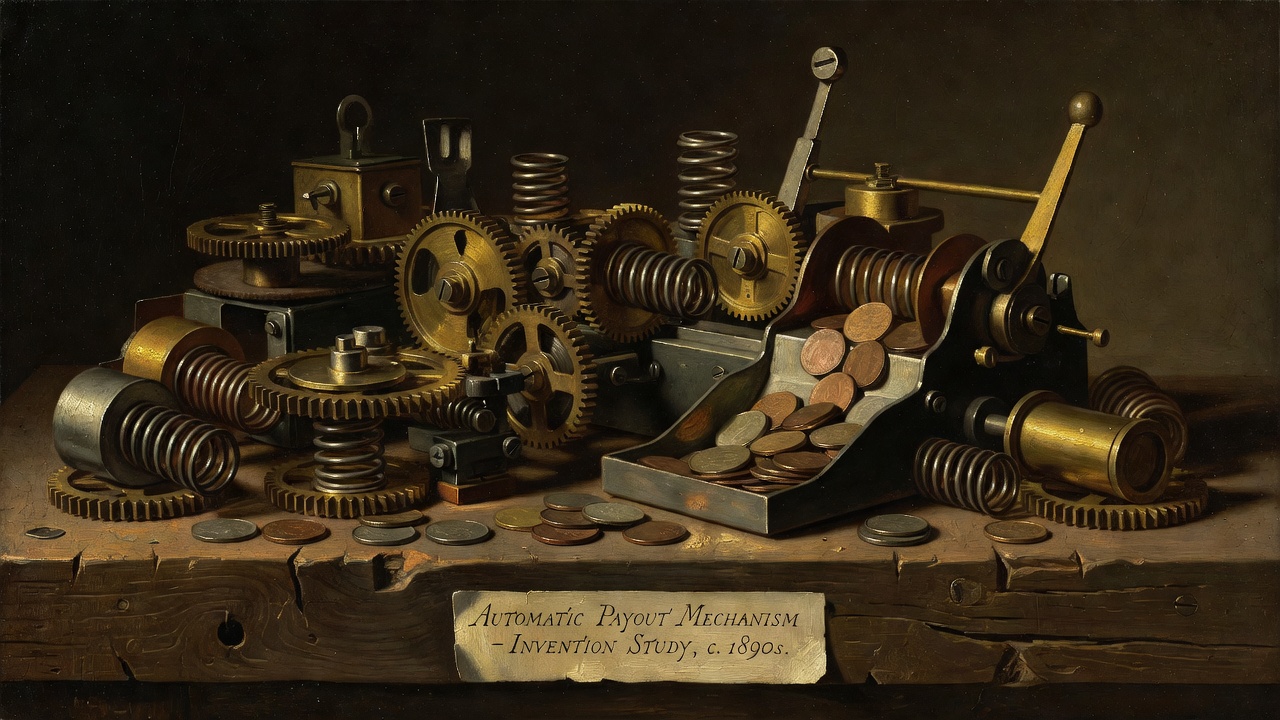
Fey designed the Liberty Bell in 1895. It had three reels. Each reel had ten symbols: horseshoes, diamonds, spades, hearts, and three Liberty Bells. The reels were linked to a mechanical lock. When three Liberty Bells lined up, the lock released a hopper that dispensed coins directly to the player.
This was the first automatic payout mechanism. The machine did not need a bartender. The machine did not need an employee to verify the win. The machine paid the player directly.
Liberty Bell was an immediate success. Fey's design was copied. Competitors reverse-engineered it. By 1910, hundreds of variations existed. The industry was born.
The Mechanical Constraints
Fey's design was constrained by mechanics. The payout hopper was spring-loaded. It could only dispense coins. The number of coins was fixed by the reel configuration. A Liberty Bell match paid between ten and fifty coins, depending on the variant.
The reels themselves were constrained by physics. A single reel can have maybe twenty symbols before it becomes too large to spin easily. Three reels mean three separate mechanical systems linked together. Complex mechanisms introduce friction and unreliability.
These constraints shaped slot design for eighty years. Slot machines from 1895 to 1975 were fundamentally mechanical. Three reels. Maybe four by the 1960s. Limited symbol sets. Limited payout amounts. The design was dictated by engineering necessity.
The Regulatory Adaptation
Casinos loved the Liberty Bell because it removed human discretion from payouts. The machine was honest (mostly). A player could not argue about a payout. The symbols either matched or they did not.
But the machine was also a legal problem. Some states classified machines as gambling devices and banned them. Other states allowed them under licensing. Fey himself ended up in litigation multiple times over patent disputes and gambling legality.
The legal landscape stabilized by the 1930s. States that allowed gambling casinos allowed slot machines. States that banned gambling banned the machines. Fey's invention became the foundation of legal casino gambling in the United States.
The Evolution
After Fey's death in 1944, the industry evolved. Manufacturers like Bally introduced electromechanical slots in the 1960s. These used electric motors instead of springs. They had more reels (sometimes five). They had more symbols. They had larger payouts (jackpots up to hundreds of dollars, unheard of in purely mechanical machines).
By the 1990s, electronic slots replaced electromechanical ones. A computer chip replaced the mechanical systems. Payouts were no longer limited by physical hoppers. A computer could generate any number. Reels could have unlimited symbols. Payouts could be anything the designer programmed.
The Modern Legacy
Every slot machine alive today, whether physical or online, traces its design back to Fey's Liberty Bell. The concept is identical: three reels (or virtual reels), symbol matching, automatic payout.
Fey solved the fundamental problem of automated gambling: How do you pay a player without human intervention? He solved it mechanically. His solution has been adapted into electronics and code, but the principle remains.
The dealer here at the table, the croupier, the person who manages the game, they trace back to a time before Fey when human judgment was required for every outcome. Fey removed the human from the outcome. The dealer remains only for games where human judgment is essential: dealing cards, spinning the wheel, announcing results. But slots, the machines, they came from Fey's dream of mechanical honesty. A machine that cannot lie.
Rooms for this read
Share this read





